Mergers amid the perfect storm – should associations combine and conquer?

As the dust settles on two recent Centrus-advised mergers between Abri and Silva, and Sovereign and Network Homes, Centrus considers the role mergers have historically played in the affordable housing sector, and why, particularly given ongoing economic and political volatility, the theme of consolidation is likely to remain in focus into the future. 


Navigating the perfect storm – why might housing associations wish to merge?

As Winston Churchill opined, “the further backward you can look, the farther forward you are likely to see”. Indeed, the practice of UK housing associations merging appears not novel, but cyclical, with each burst of activity more pronounced, with ever greater calls on finite financial resources.

Understandably, during significant uncertainty, such as that caused by the pandemic or the 2008 financial crisis, housing associations had very little time to peruse the sector for potential partners, instead focusing on the immediate concern of getting their own houses (pardon the pun) in order.

Furthermore, while we don’t possess a crystal ball, consolidation looks set to continue, with the total number of UK housing associations decreasing nine per cent in the past decade alone, according to statistics from the Regulator of Social Housing.

For an increasing number of housing associations, this landscape has forced at least consideration of mergers and the appeal of ‘combining and conquering’.

Partnering with an organisation with complimentary geographies and ambitions is an attractive prospect for some, particularly where resources may be stretched thin. The benefits of a merger will vary and be specific to the organisations involved. However, as a general rule, the key advantages of undertaking such an exercise include:


1. Economies of scale, efficiencies and bargaining power

Often the primary driver behind any merger, and the most obvious benefit, is the resulting pooling of resources to achieve economies of scale. The newly merged organisations will benefit from sharing administrative and operational platforms, reducing duplication, eliminating costs and improving efficiency.

Furthermore, the newly formed, larger, housing association may have greater negotiating power via balance sheet strength and an enhanced credit profile, offering improved outcomes with investors, rating agencies, suppliers and local authorities.

There is a risk of diseconomies of scale. When considering a merger, entities must carefully evaluate how the combined organisation will operate and the pathway to that outcome.


2. Financial stability and improved risk management

Combining the financial resources of two or more housing associations can result in greater financial stability, providing a more secure foundation for delivering housing services and investing in property development and maintenance.

Additionally, there is a reasonable expectation of risk diversification across a larger number of properties, potentially reducing exposure to specific challenges or risks in a single geographic area or property type, such as flood risk.

Again, careful due diligence on the asset base of each partner is required to ensure the resulting portfolio of homes achieves the aspirational profile.


3. Improved service delivery and development capacity

Mergers can enable housing associations both to increase their development capacity and to provide and invest more into a broader range of community services for tenants.

The combination of cost savings and enhanced bargaining power achieved via merging may unlock additional building capacity for the merged entities to deliver new affordable housing units.

However, in a larger organisation, the distance between the tenant and the board may increase; careful consideration of operational structure is needed to ensure due focus remains on delivery for tenants.


Challenges

Overall, the case for mergers appears strong.

The saying about laws being like sausages (best not to see how they are made), applies to mergers as well. Mergers are complex, representing a substantial undertaking for all stakeholders and are not to be undertaken lightly.

While mergers can offer excellent benefits, this requires careful planning and execution.

Achieving the merger may require lender consent solicitation initially, while unlocking maximum capacity may need financial covenants and corporate controls to be reshaped.

Both can engender potentially complex and expensive negotiations with lenders. These can result in treasury costs, and ensuring they are outweighed by savings is a critical test of a business case.

Cultures will need to be harmonised, tenant concerns surveyed and allayed, while employee stakeholders will see significant disruption, but potentially a broader range of career development opportunities.  

The resulting, larger entity will naturally be more complex, and it is reasonable to expect some short-term administrative challenges to ensure all parties are comfortable, from governance and risk management perspectives.

However, it is important to ensure that this is transient; any long-term drag on decision-making speed can result in poor responsiveness, worse outcomes for tenants, and undermine any business case.

Mergers also have the potential to result in overextension during execution, where the level of effort required to deliver the process is too big for the existing personnel to achieve effectively.

This is where the selection of experienced advisors can be critical to ensure that lender negotiations are successful, and the loss to EV (with EV representing the present value of existing borrowing versus a like-for-like replacement at current market rates) is minimised.


Key success factors


1. Choose the right partner

Easier said than done, but the success of any merger depends first and foremost on selecting the right merger partner. A shared vision, culture and geographic focus are key to reducing the risk of integration issues.


2. Evaluate the business case early

Careful planning, effective communication and a clear understanding of the objectives of any merger are vital. A key step in merger execution is constructing an outline business case which should define the ‘merger ambition’ and assess to what extent the merger may deliver this.

It’s also important to ensure that the interests and needs of tenants and communities are at the forefront of the merger process. Ongoing tenant engagement is paramount (often formally required) throughout the process to ensure they feel their needs are heard and any dissatisfaction avoided.


3. Get the right support

Depending on the entities involved and the legal mechanism opted for, the transaction can take between six and 18 months to complete. During this period, there is likely to be an operational drag on day-to-day business, with deal-fatigue a real risk.

Mergers are not insignificant in terms of cost and will require specialist support from financial, legal and operational advisors to execute effectively. Selecting the right professional partners is important.

Creating resilient businesses

Mergers are not a universal cure for operating pressures. They have, however, been used successfully to create more resilient businesses that are greater than the sums of their parts.

Organisations should be prepared not only to proactively consider mergers, but also how to respond if approached, as many neighbouring entities will be pondering the same conundrum of how best to navigate their current challenges.

This article was originally published in Social Housing Magazine on 31st October 2023.

Phil Jenkins on ‘Pulse of the City’ | City A.M.

City A.M. | Pulse of the City

In today’s economic landscape, businesses are navigating a storm of increased interest rates, inflation, and rising energy costs. But amidst these challenges, there’s a glimmer of hope for the future.

In City A.M.’s latest Pulse of the City episode, Phil Jenkins, Managing Director and CEO at Centrus, discusses the future of the City of London.


Part 1 | Adapting to a volatile market: challenges & optimism

Part 1 dives into the struggles faced by borrower companies, the quest for stability and adaptability in a volatile market, and the painful adjustment to a high-interest rate environment economic challenges.


Part 2 | Purpose-driven culture: attracting top talent in London

In Part 2, Phil discusses the city’s changing landscape, including the rebound in office attendance and the challenges of flexible work arrangements. Phil also shares a vision for a greener and more diverse London, with improved amenities and attractions.

You can watch more episodes from the Pulse of the City video series at Cityam.com.

Strategies for HAs to consider when navigating the current interest rate environment

Introduction

Over the past decade, management of interest rate risk has predominantly involved embedded fixes on fixed-rate loans and typically long-term fixed rate funding from debt capital markets (DCM).

Hedging was a relatively benign topic when rates were at record lows. Following the substantial increase in interest rates over the past two years, HAs may fear ‘locking-in’ at relatively high rates.

The downwards sloping yield curve has increased attention on varying funding tenors as well as hedging alternatives.

Interest rate risk still needs to be managed and with lower capital markets issuance volumes, HAs are increasingly looking at bank hedging options as these risk management tools return to the fore.

In this article, we explore some of the different hedging strategies HAs can consider on a ‘standalone’ basis using the International Swaps and Derivatives Association’s (ISDA) master agreements, to mitigate risk and optimise treasury positioning.

We do not comment on embedded hedging and/or an increasing trend for some banks requiring this to be transacted in loan linked ISDA agreements.


Interest Rate Swaps

Interest rate swaps are one of the most common and simple hedging options.

A swap removes interest rate variability on a floating rate loan, exchanging a variable interest rate for a fixed one over the duration of the swap.

Executing a swap has the advantage of mitigating interest rate risk, but it is important to note there is a cost and there are complexities that need to be considered.

Swaps are typically executed with banks under ISDA master agreements (with a credit support annex) and collateral is typically required by the bank counterparty in the event interest rates fall.

From a collateral perspective, there is normally an unsecured threshold above which you allocate a pool of security and if this provides insufficient cover there would be a need for cash collateral.

Availability of unencumbered assets and efficient use of security, plus potential exposure to cash calls, are key considerations.

Swap rates are currently highest at the short end, with the Sterling Overnight Index Average (SONIA) forwards peaking in 12 months, before gradually falling to long-term levels of circa four per cent.

An HA needs to consider when to start the swap, as forward starting swaps can avoid the SONIA peak altogether.

For example, while the seven-year swap rate might be 4.4 per cent, a seven-year swap starting in two years could offer a more favourable four per cent.

In this example, interest rate risk would apply to the HA for the first two years and so funding requirement, liquidity and interest exposure should be assessed before entering a transaction.


Interest rate caps – mitigating downside risk

Interest rate caps offer an alternative hedging option, permitting borrowers to protect themselves from rising interest rates while retaining the benefit if rates fall. Caps are typically executed with banks under ISDA master agreements.

Under an interest rate cap, the borrower’s interest rate remains floating but only up to a specified cap level, above which they are effectively fixed.

The borrower pays a premium for this protection, typically as an upfront cost, though some banks may allow this to be deferred and spread over the term of the cap.

The cap level (strike) and tenor determine the premium paid and can be set based on how much interest rate increase can be absorbed by the business plan. The higher the cap level is, the less interest rate protection and hence the cheaper the premium.

A key benefit of caps that have been paid upfront is if rates rise above the strike or the interest rate volatility increases, it can become a financial asset, however if rates or volatility fall, there is no liability.

For this reason, and unlike for an interest rate swap, the credit risk of the borrower is not a consideration when a bank assesses pricing for a standalone cap. Therefore, often credit approval processes are faster (or not required) and notional appetite is greater.

It is important for borrowers to carefully balance and assess the required cap level and associated premium versus forecast interest rate exposure.


Interest rate collars – balancing risk and premium

To reduce the premium associated with an interest rate cap, a common strategy is for a borrower to enter an interest rate ‘collar’, where an interest rate floor of the same duration is entered into to offset the cap’s cost.

By optimising the combination of floor and cap levels, a borrower can significantly reduce the cap premium paid.

It is possible for a nil premium to be achieved, depending on risk tolerance and specific hedging objectives.

It is important to note that a collar is similar to swaps in some respects, and can be a liability if the floor becomes worth more than the cap.


Conclusion

Given the ability to manage interest rate risk more flexibly, it is perhaps no surprise that interest rate swaps, caps and collars are gaining prominence.

As with any hedging product, decisions should be made following careful analysis of a loan portfolio, the risks associated with the product, and the impact of future scenarios such as prepayment costs if hedging were closed out prior to maturity.

ISDA agreements can provide a number of benefits, but they also come with risks that require careful consideration.

For more information on any of the solutions discussed, please contact Jonathan Spearing.

The article was originally published in Social Housing Magazine in August 2023.

Insurance premiums are rising for RPs. What can be done?

Rising insurance premiums

Since 2020, insurance premiums have increased substantially, putting further pressure on operating margins for the sector.

A combination of fire safety, weather-related risks, inflation in reinstatement costs and some insurers getting cold feet has resulted in a very different insurance market today.

The insurance industry is putting a greater emphasis on risk exposure, which is subjective.

Loss ratios, which are factual and backward-looking, are probably a source of frustration for the sector given the rate of increase in insurance premiums.

A bit like pricing the risk of default on a loan, pricing the risk of a weather-related event involves a huge amount of data, an interlinked financial system and a degree of judgement.

After the financial crisis, the risk premium paid for capital increased substantially but normalised in about a year.

Despite a recent ‘once in a 100 years’ pandemic and a cost of living crisis, risk premium on debt or credit spread is currently relatively low by historic standards.

However, the price of re-insurance is probably going to stay high for the foreseeable future due to a more volatile global climate.


What can RPs do to keep the price of insurance under control?

Some of the largest RPs in England have strong enough balance sheets to explore the possibility of a captive insurance agent, which are insurance companies within a group that access the re-insurance market directly.

The credit strength of some RPs could in theory lead to attractive pricing. However, given the legal and regulatory complexity, it is understandably very rare in the sector.

Increased excess amounts or partially self-insuring up to a set level is the most obvious option.

Full self-insurance, which involves setting aside funds to cover potential losses instead of purchasing insurance coverage, is not a particularly attractive option for a risk-averse sector with a long track record of raising capital and no defaults.

Lenders typically require RPs to maintain insurance on charged stock ‘that is usual for RPs and whose practice is not to self-insure’.

Where higher excess levels sit within the definition of ‘usual for RPs’ is an interesting question.

If borrowers take significant action to reduce insurance premiums by rebalancing risk, lenders may seek to adjust their approach to loan security or request detailed risk assessments and mitigation plans.

The importance of quality stock data and information knows no bounds.

At a time when business plans are stretched and headroom on loan covenants is low by historic standards, introducing elements of self-insurance or a potential and material one-off cost of insurance excess needs some careful thought.

How much headroom would be eroded? How much time would there be to react? What is the potential liquidity impact? Is there a reputational risk with other stakeholders?

There may be a way for RPs to collaborate to either pool risk or combine credit strength to reduce the cost of insurance.

However, this is a highly complex proposition with varying degrees of risk and risk management across RPs.

A specialist insurer with a different way of underwriting the risk for the difficult pockets of stock is probably the best alternative to explore if conventional insurance solutions are not economic.  

Web 3.0 and blockchain technology could reduce insurance premiums in the future by enabling the creation of smart contracts, streamlining through decentralised insurance platforms, and improving risk assessment through big data.

While RPs wait in hope for this potential revolution, they will want to tread carefully and consider the potential treasury impact of any options being considered.

Originally published in Social Housing Magazine

Market reaction to recent Thames Water announcements & press coverage​

Key events

DateEvent
27th June
Thames Water CEO, Sarah Bentley, steps down which had not been expected by the market
28th JunePress including BBC and the FT articles indicated that Government ministers have discussed the potential for a temporary nationalisation of Thames Water
29th JuneMoody’s published a comment entitled “CEO resignation likely to increase scrutiny, but strong liquidity supports credit quality” in response to the ongoing situation but did not take any rating action
30th JuneOne of the largest Thames Water shareholders, Universities Superannuation Scheme indicated it would support a turnaround plan
30th JuneS&P put Thames Water’s Class A and B debt on credit watch with negative implications over uncertainties around the management transition and timing of the additional equity injection 

Market reaction

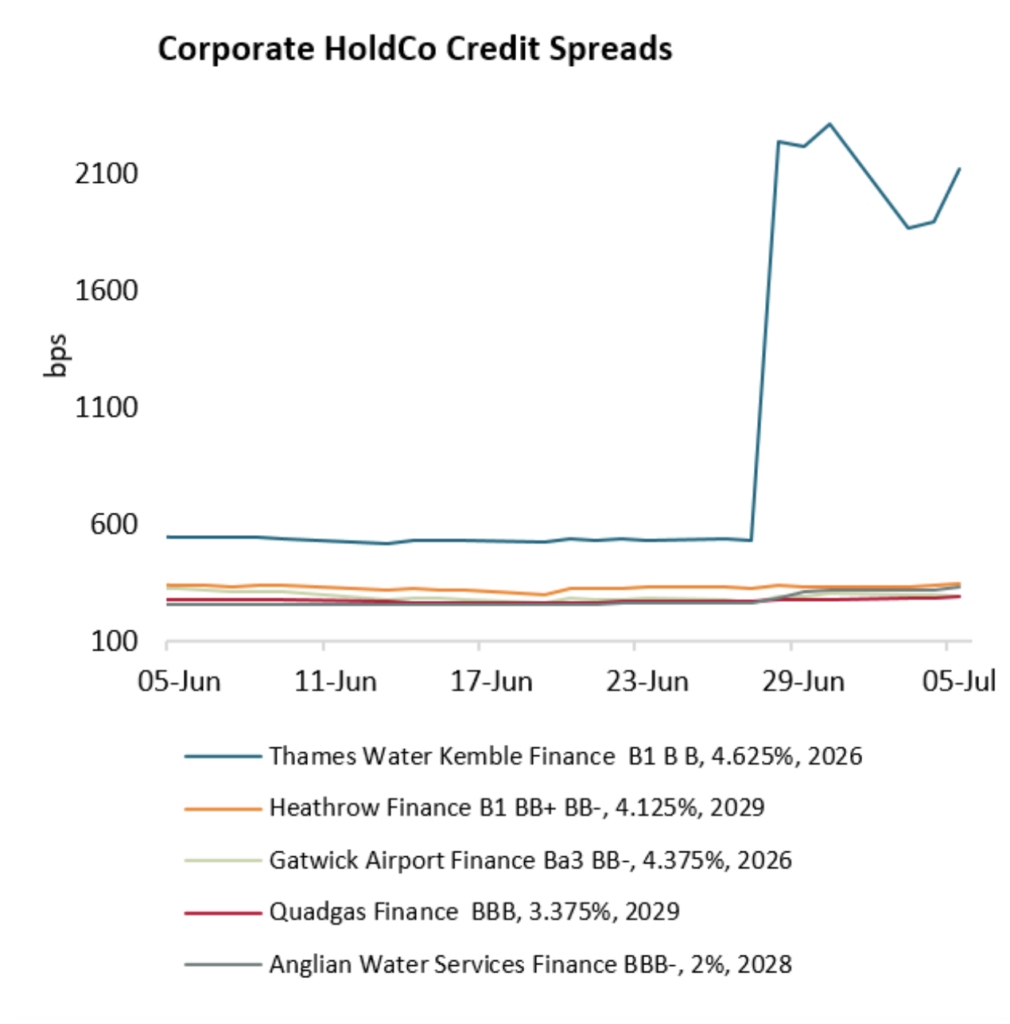
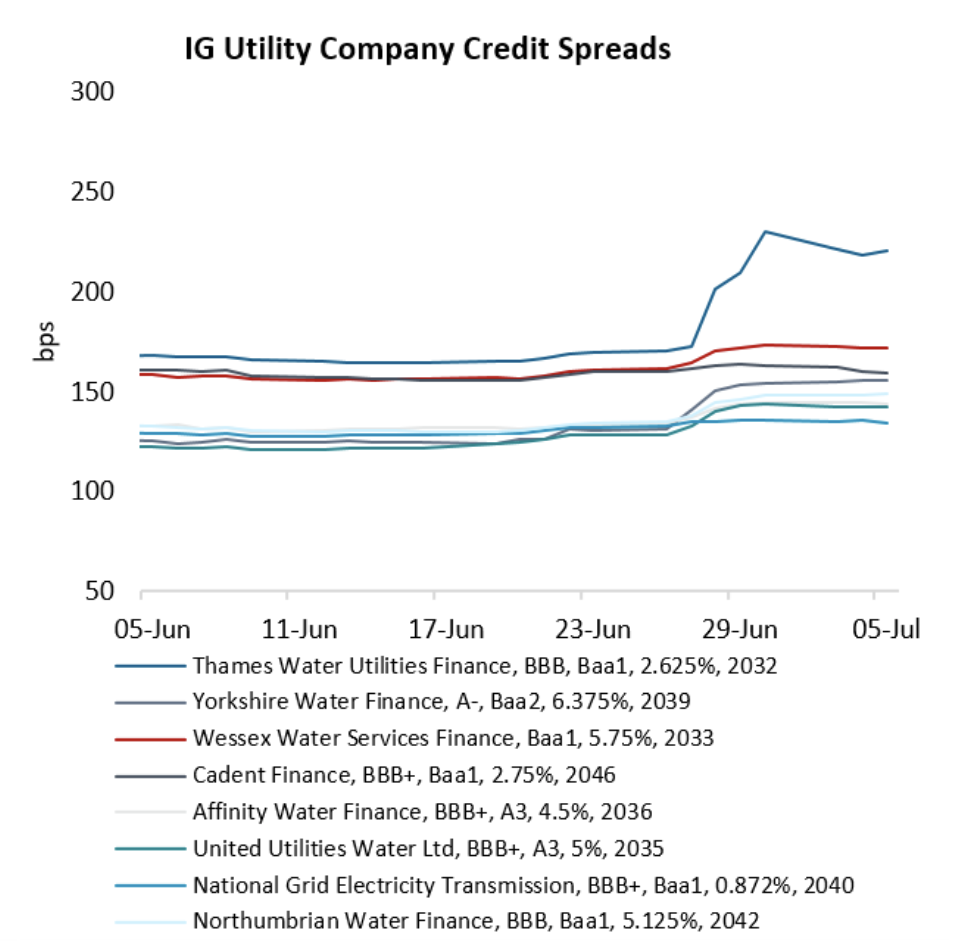
  • News surrounding Thames Water led to increases in its bond spreads, which are most pronounced at Thames HoldCo (Kemble) where spreads initially widened to +2,241 bps but have since tightened.
  • The impact on wider water and regulated utility sector spreads is relatively mild, with some modest spread widening seen at Opco level but mostly not out of line with a slight widening of iBoxx £ Utilities 10+ bond spreads over the same period. New issuance in recent days from Cadent and Heathrow implies robust demand for infrastructure credit.

Centrus view

The impact of recent news flow has been substantially limited to Thames Water and we expect that once clarity is provided on the timing of further equity injections that market conditions will revert.


History of recent water sector equity announcements

DateEvent
August 2021Southern Water received a £1bn equity injection from its majority shareholder to recapitalise the business and implement a more sustainable financing strategy
June 2022Thames Water pledged an equity injection of £500m and a further £1bn of equity by the end of the regulatory period, subject to further conditions
June 2023Yorkshire Water raised £500m from shareholders, this was part of £940m program agreed in October. Funds are to be used to repay intercompany loans and fix water spills after Ofwat investigation
Sources: Financial Times, Thames Water website and Bloomberg

For more information, please contact Adam MacDonald, Managing Director – Centrus

What is a treasury management system?

What is a Treasury Management System (TMS)? 

A Treasury Management System (TMS) is designed to help businesses manage their cash and liquidity, financial risk, and other treasury related processes.

A TMS can automate a variety of treasury tasks from routine calculations to transaction initiation. It also greatly facilitates analysis and forecasting of treasury and risk management, contributing to greater straight-through processing (STP).


titanTreasury™

titanTreasury™ is a robust and dynamic cloud based TMS that will support your company’s continuity and flexible business operations.

titan is deployed in a hosted environment, allowing our clients to benefit from ongoing maintenance, upgrades and system support. 

Our financial advisors review current treasury and risk workflows to enable the configuration of automated processes.

  • Cash Management: Clients can integrate non treasury related cashflows, manage intercompany transactions and control liquidity and bank reconciliation.
  • Operation Workflow: Enter transactions, generate payment confirmations and schedule tasks in a single platform for smooth operation management.
  • Regulatory Reporting & EMIR: titanTreasury generates an array of documents including declarations, debt profiles, EMIR and IFRS7/9/13 reports.
  • Estimated Budget Cashflow Forecast: Make sound decisions by calculating and managing forecasts while integrating the budget of subsidiaries.
  • Audit & Security: Remain compliant by managing profiles and user rights as well as encrypting all sensitive communication and data transfers.
  • Valuation & Position Analysis: Use the platform to carry out consolidation position, amortised cost and portfolio analysis, as well as market-to-market valuations.
  • Payment Schedules and Accounting: Track payment schedules, report accounting information and forecast P&L results for a seamless approach to treasury management.
  • Financial Data: Ensure that all of your valuations are accurate with real-time access to live financial market data and updated yield curves.
  • Risk Analysis and Hedge Accounting: Conduct sensitive analyses via stress tests, ‘what if scenarios’ and activity measurement as well as assess the risks of CVAs and DVAs.

To learn more about the benefits of titanTreasury™ or to book a demo, please contact Gilles Bonlong, Head of System Implementation at Centrus .

titanTreasury™ is owned and developed by 3V Finance, and delivered by Centrus.

This is Centrus Analytics

Meet the Centrus Analytics Team


Solutions and Offerings

Centrus Analytics is the technology branch of Centrus. We help organisations improve efficiencies and control with technology-led solutions, including:

  • Hedge Accounting and Valuations : supporting clients with hedge accounting requirements including strategy, effectiveness testing and documentation. Our platform is also built to perform complex valuations on vanilla and complex financial instruments.
  • Treasury Management System: titanTreasury is designed to support treasury functions and flexible business operations, giving your team greater visibility and control.
  • Data: Our data solutions unlock insight into opportunities that our clients can take advantage of by transforming data into information, and that information into actionable knowledge.

For more information, or to book a demo, please contact Gilles Bonlong, Head of System Implementation

Demystifying derivatives: A commercial and accounting perspective

Introduction

Heightened market volatility, a sharp rise in global interest rates and increased flexibility for restructuring derivatives has reignited queries from our clients about derivative valuations and restructuring or unwind costs. Large swings in the value of derivative portfolios have put ever more scrutiny on accounting valuations and how these are presented in accounts.

In this refresh of the original 2017 white paper, we take a refreshed look at derivative valuations: 

1. Mark-to-Market of a derivative or ‘mid MtM’, represents the Net Present Value of all future projected cashflows to be received and paid, discounted at a risk-free rate (SONIA, SOFR, €STR). This is valued on the same basis as that typically received in valuation reports from banks and is still often used for accounting purposes.

2. Transaction value of a derivative is the ‘Mark-to-Market’ taking into account credit, bank funding, regulatory capital implications as well as trading costs. It may also factor in the bank’s (or corporate’s) wider derivative portfolio, wider strategy, and commercial considerations. These factors may impact a derivative valuation when unwinding or restructuring a derivative prior to maturity.

3. Accounting value of a derivative can be the same as the ‘Mark-to-Market’ described previously, but increasingly often takes into account certain accounting valuation adjustments that depend on the relevant accounting standard. 10 years on from its implementation, IFRS13 puts a greater emphasis on credit valuation adjustments to the ‘Mark-to-Market’ for accounting purposes which mirror a transaction value.  In some cases a funding valuation adjustment is required too.

Read the full whitepaper below:

For more information, please contact Adrian Li, Managing Director – Centrus

All Energy and Decarbonise 2023

All Energy and Decarbonise, Glasgow 2023

I made my inaugural visit to the All Energy and Decarbonise conference in Glasgow SEC last week with members of our Infrastructure and Energy Transition team , whose positive feedback on the event was unanimous: it was a productive, dynamic occasion, well attended by key players in the energy transition network.

Below is a snapshot of what I found to be the most compelling messages cutting through.  

Less mouth more trousers

Globally we have bold 2030 investment and 2050 net zero commitments in place, but as the clock ticks and the breaching of our planetary boundaries becomes increasingly terrifying; the time for talk has passed and we need action and delivery. 

In Glasgow, it was reassuring to see the huge range of technology and project development that is already on the table. Exhibitors showed off pioneering assets across wind, solar, hydrogen, marine, private wire, hydro, interconnection, carbon sequestration and energy storage.  With consumer expectations adding huge weight to the support they need, we are seeing decisions on execution and investors becoming bolder with the risks they are taking.  Private and Public Sector funds are now going where the problems are.

Swap the plans and promises with action

The presenter’s lineup was strong.  In the opening plenary session, Jacqueline McLaren, The Lord Provost of Glasgow, Humza Yousaf, First Minister of Scotland, David Bunch, Country Chair of Shell, Chris Stark, CEO of the Climate Change Committee and Susan Aitken the Leader of Glasgow City Council took to the stand.  They shared their concerns and conflicts, but they also shared their commitment, raising their hands to admit that disagreements need to be put aside.  Together they recognised that scientific, public, corporate, council and government teams need to collaborate on the common net zero targets if we have any chance.  This hope was backed up by the exhibitor population from across all pieces of the puzzle.  The development across the renewable energy product life cycle is gathering pace every week and it was underpinned by a common theme of less talk and more action.

‘Just’ must be everywhere

The other message that resonated for me was the recognition that the word ‘just’ has to play a key part in every component of energy transition.  We must show that we have learned lessons from damage done by industrial change in the past – all close to home in Glasgow.  We must include the education, social and people impact at every step of the way.  Recognising the jobs and education opportunities that the green economy must grow was shouted about by the strong academic research in the visitor population as well as the carbon literacy and renewable energy studies from the students in attendance.  It was impressive stuff.

Centrus exhibited in a central hot spot for attendee footfall: we were neighboured by Tesla, The University of Edinburgh, Shell and ETZ.  The contributions from our energy transition and infrastructure corporate advisory team were very strong, with everyone working hard to show off the Centrus brand, our sector expertise and our credentials.  We connected with over 100 new and existing contacts and will reach out to identify opportunities where we can provide support.  B Corp as a certification was relatively unknown to this audience, (with the exception of Thrive Renewables PLC) and our B Corp branding raised many interesting discussions about the value of using your business as a force for good.

There was lots of promise: I hope that the pioneering ambition of Scotland’s renewable energy transition that was shown off at All Energy Glasgow 2023 translates into further operational examples by this time next year.

If you want to discuss the event, the themes arising or the role that Centrus is playing, please get in touch with George Roffey, Sustainability Officer – Centrus.